VOLCANIC ACTIVITY IN THE MALVERNS
9 March 2012
This short talk was given by Richard Edwards which reviewed
his recent investigations into the possibility of there being volcanic rocks in
the North Malverns. For additional reading see Richard’s article in the EHT
Earth Matters magazine, to read click
here.
The lecture started with a review of volcanic processes in general, then
volcanic activity in the Malverns, and finished off with a review of Richard’s
latest research on the possible volcanic rocks on North Hill.
Richard began his talk with an impressive slide of an
explosive volcanic eruption in full spate and asked us to imagine the Malverns
576 million years ago when such an event might have occurred.
His next slide reminded us of the plutonic and volcanic associations, showing
us magma chambers at
different levels with different rates of crystallisation.

Plutonic and Volcanic
Associations.
Using the diagram of Classification of Igneous Rocks he told us how
igneous rocks’ names are related to their mineral
content and grain size.

We could see that the two main families of minerals are the
Ferromags containing all the
iron and magnesium and the Feldspars, -
themselves being divided into plagioclase
feldspars and alkaline feldspars.
Ferromags are basically silicate minerals (olivine, pyroxene, hornblende and biotite) which react with the
magma as it cools. They are continuously crystallizing and interacting to form
different minerals as the magma cools. An analogy: an apartment block is
knocked down and the bricks are used over and over to rebuild buildings of
differing architectural designs.
On the other hand we can think of the plagioclase feldspars
as a block of apartments which stays the same, but the contents are constantly
being rearranged as the magma cools, to form minerals varying from 100% calcium
at one end of the scale, then as the feldspars evolve plagioclase is changed
into a
90% sodium –rich variety.
Thus the two main players of igneous rocks are the
ferromags and feldspars.
The main thrust of the lecture was to talk about two
principal rock types which crop out on the North Malverns
a) Dolerite
contains calcium rich plagioclase whereas the ferromag is a pyroxene. If the
dolerite is very fine grained it becomes a Basalt. Hunt around in
Dingle Quarry to find a dolerite dyke intruding into granite.
b) Micro-diorite is a
coarser grained rock where the plagioclase has approximately similar
proportions of calcium and sodium and with the ferromags commonly being
hornblende and a good example can be seen at Ivy Scar.
Moving on to a revision of the types of lava which depend on the
composition of the magma and type of volcanic eruption . A gentle basaltic flow
commonly forms a ropey lava (pahoehoe) as
seen in Hawaii. Violent eruptions throw
out much gas, ash and cinder forming Tuffs which vary in grain size depending on
proximity to the eruption. Ignimbrites are the
products of very hot gases and materials flowing down the side of the volcano.
Finally, undersea eruptions form pillow lava as seen in Shetland and a poor example can be seen
at Broad Down at Giant’s Cave.

Types of lava: pahoehoe on
left and cinder-like ‘aa-aa’ on the
right.
.

Devonian pyroclastic rocks seen in
Shetland - imagine the pyroclastic flow
being blown off the side of the volcano as rocks and falling as volcanic ash.
Bedded and massive tuffs
seen in Charnwood Forest.

Ignimbrites on Shetland - examples also occur at Reservoir Quarry, in
the Malverns but are difficult to decipher.
At Dingle Quarry is found a
dolerite dyke as a sub-volcanic intrusion into granite, the dolerite being a
calcium rich plagioclase dominated by pyroxene.

Dolerite dyke (dark grey
colour) at Dingle Quarry.

Image shows how Herefordshire
Beacon is thrust westwards over steeply dipping Silurian rocks. Volcanic rocks
of the Warren House Formation occupy the low ridge to the east (Broad Down).
Rocks comprising the Warren House Formation;
a. Tuffs - Broad Down (lithic tuffs
made up of fragments of rock and crystal made up of individual crystals)
b. Ignimbrites - Reservoir
Quarry
c. Pillow lavas – Giant’s
cave on Broad Down
Interpretation:
definite volcanic activity, occasionally violent, with some interaction with
sea water.
At Ivy Scar there is a good example of a medium-grained
micro-diorite with hornblende as the main ferromag. A sub-volcanic intrusion, the gently dipping
planes of weakness are likely caused by stress release of due to removal of the overlying rocks by
erosion.

Micro-diorite at Ivy Scar
rocks.
Further exploration of North Hill found an exposure of
fine-grained brecciated
basalt .The decision was made to have a petrographic study carried
out on two samples from the locality. The slide below (left) shows the basalt
with plagioclase phenocrysts aligned as
a result of flow whilst still molten.
The slide on the right contains a phenocryst of altered olivine. The rock is an olivine
basalt but probably formed in a high level dyke rather than as an extrusive flow.

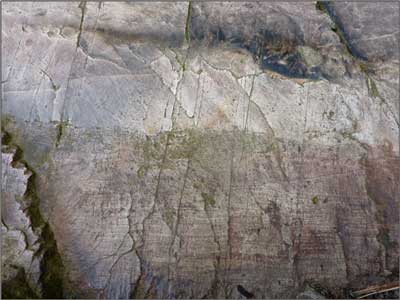
A most enigmatic exposure was spotted by Tim Carter along Alice
Betteridge Walk and was cleared of soil and vegetation by Richard Edwards, John
Payne and Tim Carter. Later the outcrop
was examined by geologists associated with the Woolhope Club Geology Section.
It was thought that brecciated layers might be of volcanic origin but that
petrographic work was required to confirm this interpretation.

Rock on the Alice Betteridge
walk.
A request was made to the National Museum of Wales for a
petrographic study on two samples from the Alice Betteridge exposure. The thin sections indicate
that the rock is a brecciated
micro-diorite, which is not strictly volcanic. The rock probably crystallised in a high level magma chamber.

Thin-section of the Alice
Betteridge rock.
Photomicrograph courtesy of Dr. Jana Horak.
Conclusions:
·
No petrographic evidence for
volcanic rocks on North Hill.
·
The Alice Betteridge rocks are micro-diorite formed in a
high-level sub-volcanic magma chamber.
·
The brecciation is probably tectonic in origin.
Bonni
Sinclair